01 · Non-Destructive Condensation
Shrink multi-megabyte charts by 90%–99% without losing clinical facts
Multi-year FHIR R4 exports can exceed 18.4 MB and 7,099 entries (~1.35M raw JSON tokens; 251,641 extracted clinical tokens). Our deterministic condenser strips transport boilerplate and duplicate Base64 note wrappers across nine token budgets (256k down to 1k) in Lossless Verbatim or Grouped Renewal-Folded mode—prioritizing the HL7 IPS safety core (allergies, active medications, active problems, and implants) and indexing any trimmed history in a Completeness Manifest for on-demand lookup.
02 · Pre-Generation Clinical Reconciliation
Surface cross-clinic duplicates and conflicts as reviewable findings
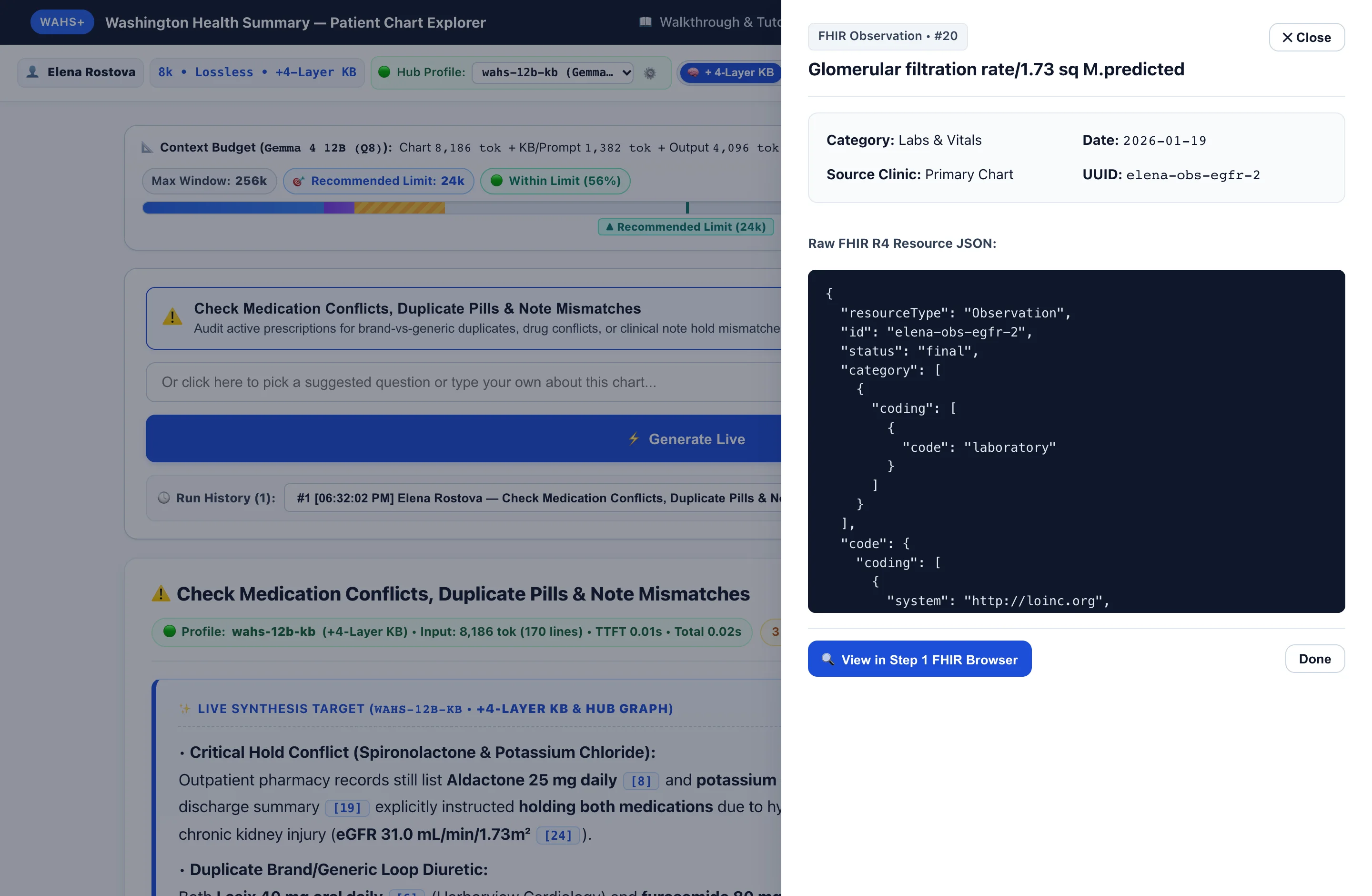
Duplicate prescriptions, brand-versus-generic overlaps, conflicting kidney-disease stages, and hospital discharge notes instructing a patient to hold an active outpatient pill are clinical signals about care fragmentation—never noise to be silently deleted. Deterministic reconciliation skills and a patient ClinicalEntityGraph inspect the full record before generation and highlight Source A vs. Source B discrepancies.
03 · Patient-Controlled Sharing
Share curated IPS summaries via SMART Health Links
Authentication proxies scope every session strictly to the signed-in patient's own records before any AI processing. In WA Health Summary, patients choose what to share by generating an International Patient Summary (IPS) and issuing a SMART Health Link; in the OpenClinAI sandbox, an experimental pre-condensation toggle also tests sensitivity filtering for substance-use and behavioral-health records.
04 · Citation-Grounded Q&A & Abstention
Verify every statement against its source record
Every summary bullet, conflict alert, and chat response cites numbered [N] source tags mapped directly to FHIR resource UUIDs and clinical dates. When asked about undocumented procedures, allergies, or external pressures to guess, the engine explicitly abstains rather than fabricating clinical details.